A ray of light is refracted through a transparent sphere of refractive index n in such a way that it passes through the extremities of two radii which make an angle θ with each other. If δ is the deviation of the ray caused by the sphere, then prove that
cos  = n cos
Text Solution
Verified by ExpertsThe correct answer is:
CHECK THE SOLUTION.
Sol. The situation is shown in the fig. From Δ BOC
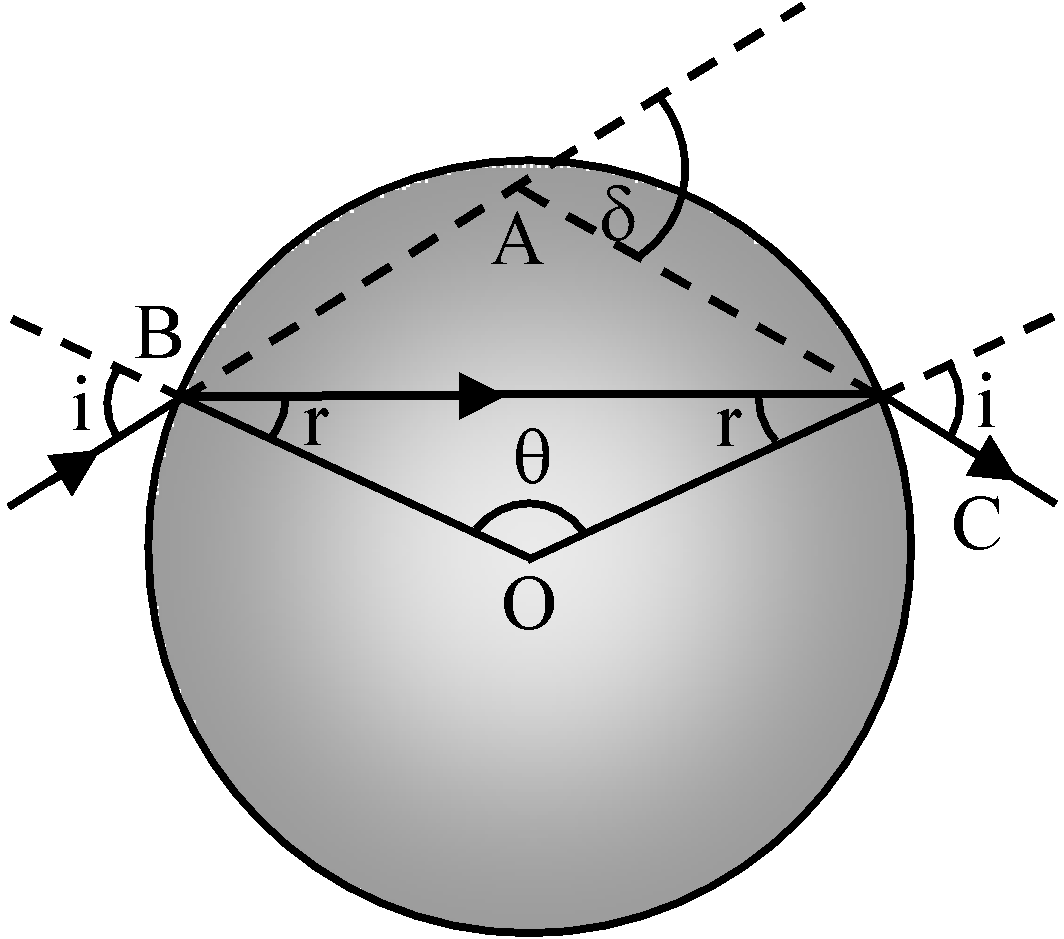
2r + θ = 180º or r = (180º – θ )/2
sin r = sin (90º – θ )/2 = cos ( θ /2)
Deviation δ = 2(i – r)
or i =  + r =
+ r =  + 90º –
  = 90º –
  .
.
sin i = sin  = cos
= cos 
Now, n =  =
= 
or cos  = n cos
Prepare Smarter with CGP Edu
Get practice questions, solutions, and test series in one place.
Write a Review
Share your experience with this question and solution.
Commentary
Send your comment, doubt, correction, or feedback to admin.
Similar Questions
Explore conceptually related problems
A student can distinctly see the object upto a distance 15 cm . He wants to see the black board at …
Two plane mirrors. A and B are aligned parallel to each other, as shown in the figure. A light ray …
A concave mirror of focal length is used to obtain the image of the sun which subtends an angle of…
A square of side is placed at a distance of from a concave mirror of focal length The centre of …
A thin rod of length lies along the axis of a concave mirror of focal length One end of its magni…
A ray of light falls on the surface of a spherical glass paper weight making an angle with the nor…